Sunday, July 12, 2009

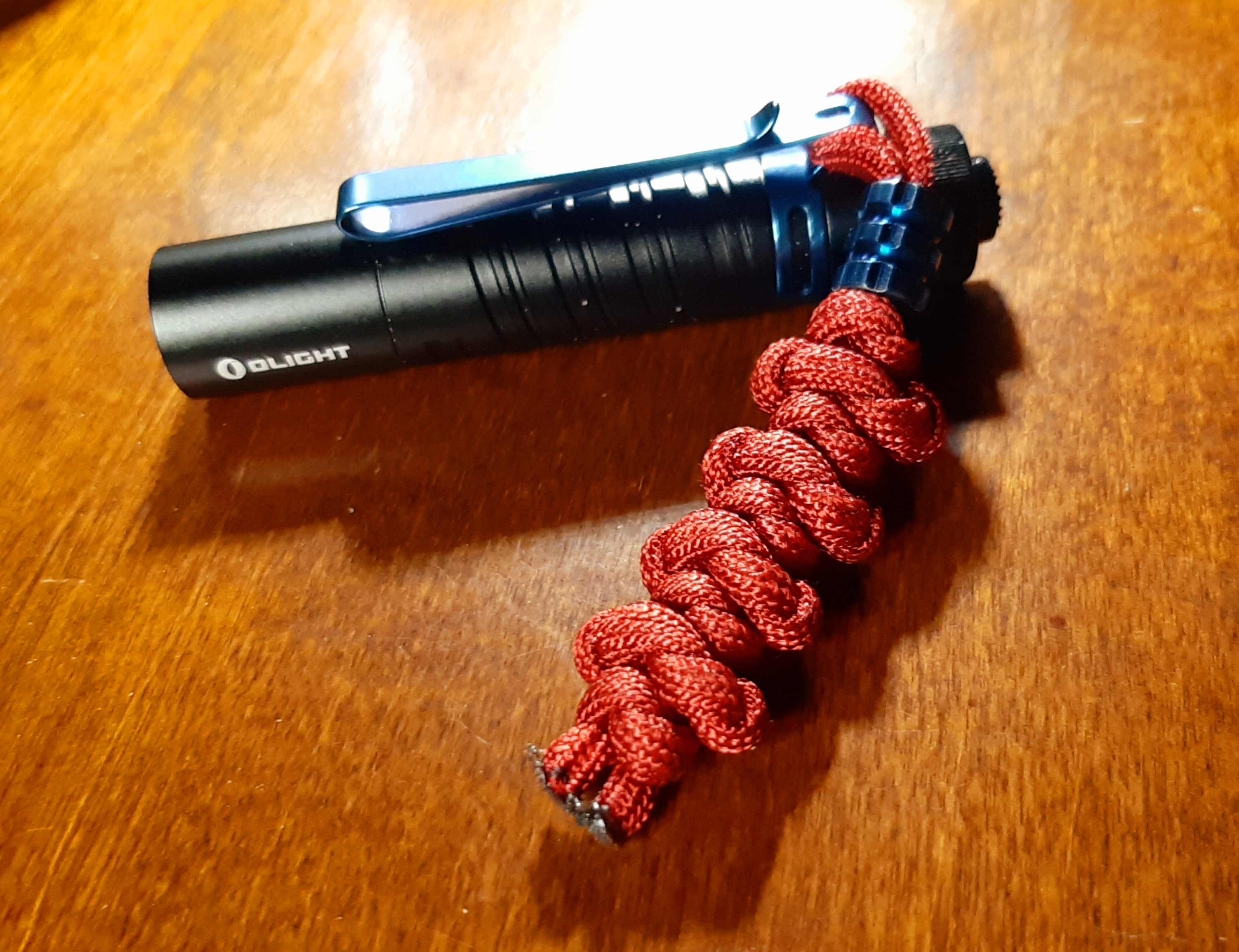
Two toned woven paracord watchband

The same weaving method as used with these previous versions of paracord bracelets was done, except two different colors of paracord were attached first(sample photo). Sew, melt, or glue them together after tucking one end into the other.

The paracord is then looped onto side release buckles, with the attached section, in between the side release buckle ends, and used as the two strand core to be woven around. That keeps the connection out of sight.

To finish, the ends were tucked back into the last couple of weaves and the excess cord is trimmed and tucked.

Thursday, July 09, 2009

Knotted lanyard/fob with cross...

Made with about 7 feet of 1.4mm braided nylon trot line, using a king cobra stitch, also known as a doubled Solomon bar or a doubled Portuguese sinnet knot.

Six lanyard knots were then tied for the vertical section of the cross, with a space between the 2nd and 3rd knots.

A separate 2 foot long piece of cord was then used for the horizontal cross section, with two lanyard knots tied, the cord ends pulled through the space left in the vertical section, then two more lanyard knots tied to finish.

Three crimp beads, from a Michaels craft store, were added to the loop section of the lanyard/fob.

The knife is a variation of the Spyderco Delica.

Tuesday, July 07, 2009

Two toned paracord fob

I tied a common noose knot for this lanyard/fob, but doubled it with two different colors of paracord.

Some folks call it a coil knot. I used about 2.5'(feet) each, of camo green and black paracord to start and only trimmed a few inches off of them when finished. There are four strands at the end, since it's doubled, two were trimmed/melted and the other pair were used for a lanyard knot.

An S-Biner or carabiner could be used, just above the lanyard knot and below the coil, to clip to a belt loop, bag, pack, etc... Or if one of the cord strands was a few inches longer, it could be used to form a loop, after the lanyard knot, and worked back into the knot.

I left the two loop ends just large enough for my little finger for added retention when using the knife(Wenger Evogrip 18).

Wednesday, June 24, 2009

Another woven paracord sheath/pouch...

This one started out about the same size as the previous one, but I decided to try tightening up the weave by working it all up towards the starting end after I had it laid out.

This actually shortened up the length by a couple of inches, before folding to secure the sides.

The side edges were brought together with a length of 1.4mm cord to form the pouch section. This reduces the amount of available space inside compared with the previous method. It made a good fit for a Victorinox Spartan or a Tinker.

I think I'm gonna try a strip of velcro sewn to the flap edge and front edge of the sheath/pouch to secure it, when I can find some. And I also need to figure out an attachment for the back of the sheath/pouch... or maybe folded back and secured as a belt loop for an open ended type pouch. Of course with that type, whatever is in the pouch is gonna need a lanyard, at least for me it would.

Saturday, June 20, 2009

Paracord Sheath continued...

For adding a belt loop to the paracord sheath, I integrated a simple cobra stitch/Solomon bar/Portuguese sinnet, with a gutted strand of paracord.

I used about a 4 foot length of paracord and with my hemostats, I pulled both ends through the sheath, at where I wanted the bottom of the loop, up the inside to where the top would be, both strands out the back and ends pulled through the center of the belt loop piece at the bottom, knotted back up to the top, and trimmed/melted the ends to finish.

Two shorter versions could be done parallel on the sheath for it to be worn horizontally instead...

I think I'd still like the option of adding a metal belt clip probably attached with a couple of short Chicago screws. I've been digging through drawers and boxes looking for an old sheath that I could scavenge a potential clip from to use, but haven't found anything suitable yet...

I'll have to see how the sheath wears over time, but maybe some needle and thread(maybe kevlar or spectra instead of the common polyster type) worked around the high stress areas, like around the belt loop ends and around the button knot, might keep them from being pulled out of place over time and moving against the woven sections around them.

Friday, June 19, 2009

Paracord Sheath

This is another try for me, at a paracord sheath. I had tried one, two or three years ago, with a knotted section of paracord(like the paracord guitar strap I made), but wasn't satisfied with it, especially being too thick, and had put the idea on the long 'things to try later' list.

A recent thread on EDC Forums had me ready to give it another go and I used weaving this time. And if you don't mind the time and effort, this method can also be used for making variations of paracord bracelets, belts, shoulder straps, etc...

I used a long section of gutted paracord(about 12 ft used in finished sheath), to weave around four sections of paracord(inner strands intact), which were centered to have 8 strands to weave around.

A sample photo showing a short gutted piece of paracord woven around the other strands to give you the basic weaving method.

I started at the lined up centered ends, by sewing one end of the 12 ft working strand to itself, around the end of the cords. Then started weaving over, under, around, and back. Continuing until I had the length I wanted(about one foot long) and finished this part like I started by sewing the end to itself around an end cord strand.

I worked each the 8 loose strands back into weave on what will be the inside of the sheath, and trimmed/melted the ends in place. I could have sewed them down, but I just went for the quick fix. I also worked a length of shock cord into the weave for a loop which would go around the lanyard knot/button knot, that I added last, used to secure the sheath flap. Other options could be done with sewing velcro sections on, maybe a button or snaps, or maybe even magnets.

I folded the completed woven section over, to form the parts for the body and the flap of the sheath, using my Victorinox Spirit as a size guide. Then I took another 5 ft section of gutted paracord and worked it around the woven edges to make the sides. Going from the top of the body, down to the bottom, across, and back up the other side. The start and ends of the cord were tucked and worked into the inner woven sections. I did have some nylon webbing that could have been sewn in place for the sides instead of more paracord, and elastic would probably be even better to allow various sized items to fit in the sheath for a snug fit, but I decided to stick with using mostly paracord for this one.

I've not added a belt clip, belt loop, or other attachment method yet and that's just something else to experiment with later...

Wednesday, May 27, 2009

Paracord grab handle wrap

I used a 26 foot strand, of green 550 paracord, to wrap the nylon webbing grab handles of my Spec-Ops Pack-Rat drop-in organizer, using the cobra stitch/Solomon bar/Portuguese sinnet.

The Pack-Rat, is a smaller sized organizer which measures 10.25"x8.25"x1.625" and can be used to keep various gadgets, gear, and gizmos organized and easier to find inside a larger bag or pack or carried on it's own. It has a length of nylon webbing sewn into three separate grab handles around the sides and top. The webbing is anchored by bar tacks at the ends of the webbing and at the corners where the D-rings are attached for the optional use of a shoulder strap.

At first, I pushed the knots closer together each time I'd tied a few, but it looked a bit bunched up that way and I preferred the look of them spaced just as they were tied, so I started over. The knots are just firm enough around the nylon webbing to grip it and barely bow it, but not collapse it. Grips will vary on different handles, so you'll have to see what works on yours with a little trial and error.

After doing one side and reaching the corner, I just continued the working ends of the cord alongside the D-ring section and then knotted over the top handle webbing. Reaching the next D-ring, I did the same with the paracord down the last section. When I reached the end of the side, I pulled both working ends of the paracord up under the bottomside of the handle, under all of the knots of that side with my hemostats, then trimmed and melted the ends to be tucked back underneath and out of sight.


If needed, the cord can be easily untied for some other use, but I actually keep 150 feet of paracord, in a couple of unopened packages, inside the Pack-Rat as part of the contents. Also inside are flashlights, multitools, knives, duct tape, screwdrivers, first aid kit, pens/paper, sewing kit, pry bar, lighter/matches, spare batteries, super glue, etc... so forth and so on, to the point that it weighs about 5 pounds and is stuffed to 5 inches thick.

Adding paracord knot work to bag/pack/luggage handles is just a simpler modern version of what's been done by others for a long time. If you spend some time googling/reading/exploring knot work and handles, you'll find current and older examples made by sailors or craftsmen, used with things like ditty bags and sea chest handles(beckets). I've seen some photos, drawings, and diagrams from as far back as the 1800's, and if only the natural materials that these older items were made of could survive longer, I imagine there would be more to see and we're left to wonder what's been lost to time.

A little security...

I have replaced the zipper pulls that came on the Pack-Rat with paracord lanyard knots. I've added the following three photos showing how to secure dual zippered bags/packs/luggage from accidentally opening during transit. It also works to make it more difficult for a deviant individual to easily/unnoticeably gain access to exposed zipper compartments if you were in a crowded situation like a busy market or riding a packed bus or train.

The loop part of the pull should just be large enough to push/pull the opposite lanyard knot through the loop, and then the second through the other. Just pull a bit on each end and you almost have a 'square knot' that's not going to easily come undone.

Last year a member of EDC Forums had asked for ideas for a 'security' knot to secure their zippers and I submitted a similar suggestion using smaller cord with a single lanyard knot/loop through a pouch's existing zipper tab holes which were too small for 550 paracord.

Thursday, May 21, 2009

Knot So Simple - CBS News Video

Earlier this week, one of my blog readers asked me about making a knotted lanyard after seeing a CBS Sunday Morning story about knots, by correspondent Serena Altschul . I googled for the story, but didn't find the video link for it until today. And of course I found it mentioned on the Knot Heads World Wide website forums. Enjoy.

CBS News video link. I would embed the video, but since the video is set to autoplay when the page loads, which I know some folks find annoying, I've just provided the link to the page.

Tuesday, May 12, 2009

Notebook knot work...

If you carry a notebook, journal, day planner, day runner, etc. and it has enough room, like the spiral binding on this one, you can try adding some paracord. The size of the book will determine how much cord you use. I ended up using close to 10 feet of 550 paracord on this 6 inch tall day planner.

It's tied similarly to a paracord bracelet, but you run the cord around the binding and back through the outer binding rings before you start knotting and again through the center of the spiral section at the end. This start used a little over 3 feet of cord without counting the knotted section. I also ran the knot strands through the outer binding to keep it close/flat and secured against the spine, but you can skip doing that if you want the knotted paracord to make more of a hand grip/handle for the book.

Friday, April 17, 2009

No Frills Spare Paracord Carry on a Boonie Hat

For those that want to carry some spare paracordwhen out and about, camping, hunting, fishing, hiking, backpacking, EDC every day carry(if ya wear a boonie hat),etc... this simple method will work just fine. I have posted other variations on 9/23/07, 5/16/07, 9/19/06, and 9/13/06.

If you've never worn a boonie hat, give one a try. They're inexpensive, comfortable, the chin strap comes in handy on windy days, and the full brim helps keep sun/rain off your ears and neck. It's similar to a bucket hat, but with a wider outward shaped brim. Fashion wise, as long as you like green, black, tan, gray, navy blue, or assorted camouflage types, there's sure to be one that fits the bill...

This method with the boonie hat ain't purty, like you might get with a sinnet, braid, weave, stitches, or other fancy knot work, but it will let you carry 50 feet of 550 cord/paracord/parachute cord, for fairly quick access. And it'll take considerably less time(for the impatient folks, and I know there's at least a couple of 'em out there) than you'd spend tying and untying knot work with all the kinks and twists that it will have in it too when it comes time to actually use it.

I like/prefer the knot work, but this is just an example for those that want something quick and easy to learn while still offering utility and being useful/functional.

I used the lanyard knot and loop(video), to secure the paracord, at the front, back, and both sides of my boonie hat, tied on the hat through the branch loops with about 1 foot of paracord used for each one. That leaves enough room to tie and adjust them before trimming off any excess. I made them after coiling the paracord around the hat the first time, so that I could make sure it would be a tight fit around the paracord and they will not come undone until you want them too.

For coiling the 50 foot piece of paracord(any more than 50 feet gets a bit bulky, YMMV), I first made an overhand slip knot/loop at one end and fit that over the hat. That helps keep the cord in place as I wrapped the cord around it. Then just continue to loop/coil the cord around the hat 'till you reach the end. Giving a bit of a twist to the cord as you go, like coiling a garden hose, keeps the paracord from developing twisted kinks as you go and helps it come off the hat easier without tangling when you remove it. Try not too wrap it too loose as it'll get messy and likely to tangle, or too tight as your head still has to fit in the hat. You can sit the hat on the floor to do this or even try it while you're wearing it.

Work each lanyard knot loop around the cord and over the lanyard knot to secure it on each side. The end of the cord usually ends up next to one of the lanyard loops, so you can just leave it tucked under one or tie an overhand knot around the previous loop to hold it in place.

I've tied it and pulled it off several times to test it out and make sure I can quickly get the paracord off without tangling, and it's worked out okay for me.

Boonie Hats

Glow in the dark thread

I gave this Superior Threads NiteLite Extra Glow thread a try for use as a dreamcatcher on a 34mm paracord covered split ring. I blunted a large sewing needle, on a diamond file, to help with feeding the thread over/around the loops when making it.

Being 30wt polyester thread, it turned out okay as a pendant to hang on a necklace or from the truck's rearview mirror, but it's not strong enough, like the 0.9mm nylon cord, to be used as a fob or lanyard. Maybe if I twisted 3 or 4 strands of it together, like a rope, it might then work... That's would be a lot of extra work, but still something different to try adding to various paracord projects.

The glow is actually not bad considering how thin the thread is and the package info said it will glow for at least 6 hours. It was still visible after that when I hung it from a nightstand lamp to test it.

Thursday, April 09, 2009

And another...

I used an oval shaped key ring/split ring with a gutted piece of paracord over it, then used 0.9mm braided nylon cord to make the dreamcatcher. For the fob/lanyard, I used some CoolGlowStuff 3/32" cord, with a snake knot to attach it to a flashlight. There's enough loop left to put my thumb through(the lanyard, not the dreamcatcher) for retention if used when boating, camping, fishing, hiking, backpacking, etc..., so that I don't lose it and a clip to attach it to a belt loop or even a watchband, to prevent loss.

Monday, March 30, 2009

A couple more...

Still playing around with the smaller sized dreamcatcher types.... For one of them, I used another smaller split ring/key ring covered with 2mm sized cord and centered it inside the knot work.

Thursday, March 26, 2009

Dreamcatcher fob

I first used a short section of gutted green paracord to work over a keyring. Then I used white 0.9mm braided nylon cord to make the dreamcatcher knot work over the keyring . And finally taking a length of 550 cord through the Spyderco knife's lanyard hole, looping the ends around the dreamcatcher fob and doing a section of snake knots to finish.

Added a few more photos. There are plenty of online instructions for dreamcatcher tying methods if you google them. You can vary the look by how many hitches you initially make around the ring and how tight/loose you you do them as you go and what cord you use.


I do the dreamcatcher before adding the paracord for the lanyard/fob, so the photo showing the cord looped around the ring is just how/where on the keyring it goes and it'll cover the starting knot of the hitching.

Tuesday, March 03, 2009

Paracord zipper pull with a label...


One of the members of EDC Forums recently started a thread asking about zipper pulls with labels. They wanted to put a BOB(Bug Out Bag/Bail Out Bag = bag or pack with emergency essentials) in the trunk of their wife's car and have the zipper pulls labeled in some way to easily identify the contents of each pocket/compartment of the bag/pack. That would certainly save some time with digging through a bag or pack when looking for specific items like a FAK(First Aid Kit), Tools, Flashlight, Rope/Paracord, Duct Tape, Knife, etc...

My suggestion was to utilize some Tyvek material, which is strong, durable, flexible, and waterproof. Over time, the material usually softens up if handled often, yet still retains it's strength. You can find some other items made with it, or make something yourself like shown with this Instructable link and this YouTube link.

For the example that I made, I cut a strip from a Tyvek envelope, colored the material with a red Sharpie, labeled it 'FIRST AID', wrapped it around a paracord zipper pull made with a 'lanyard knot', and used some glue to attach it to itself. Different colors could also be used as a personal 'code' for the contents with or without labeling them.

If Tyvek material isn't used or available, maybe paper with scotch tape over it to protect it could be used, or a clear section of a straw/clear tubing might also work to fit over the label, etc... I'm sure some folks can come up with some interesting ideas to try.

Wednesday, February 25, 2009

Lanyard knot paracord cross

The 'lanyard knot' is also called a diamond knot/boatswain's whistle knot/Chinese button knot/knife lanyard knot and there's probably a couple more names for it out there depending on the source.

For this paracord cross, I used two strands of paracord. I used a couple of strands that were about 3.5 feet for the vertical section with six knots and 2.5 feet for the horizontal section with four knots. The inner strands were left in, but this could be done with the cord gutted.

With one strand, from the center, I made a small loop then tied six lanyard knots for the vertical section. Each knot is worked up as close as possible to the previous one, except for a bit of space left between the second and third knots for the cord of the second strand to pass through.

The second strand has four knots, the first two knots tied and worked close together, then I pulled the two working ends through the space in the vertical section, and tied two more lanyard knots, working them close together to eliminate any slack. The working ends from both sections are trimmed and tucked back into the knots.

And a another one made with gutted cord and used as a pocket knife fob.


The knots are tied one after the other, with the slack between them worked out before tying the next knot.

Saturday, February 07, 2009

Paracord holder for a 2 liter soda bottle...

Here's one way to use 70+ feet of paracord for a 2 liter bottle carrier. I occasionally reuse the soda/coke/cola bottles as water bottles.

Five separate sections(about 12 ft of cord each, made like a paracord bracelet without a buckle to about a 12 inch length).

Then center looped onto a small split ring at the bottom of the bottle, knotted each of the five paracord parts to the same length, ran a short length of paracord(1 ft piece at the top secured with a Black Crater Cord Lock Light) to secure the five parts at the top.

Then ran another long length of paracord(14 ft), starting at the bottom by tying a knot at one end and zigzagging up then down from one section to the next, and just looped the cord I had left around the top a few times.

I just used what I had for the zigzagging cord, but you could end up using a lot more if desired for that part by running the cord closer together as it's worked up, then down each section and maybe crossing the lines up going around again....

It was kind of hard to see the cord with the water in the bottle, so I added another photo.

A separate paracord strap or handle could be added, or carabiners might be used to clip the bottle to a bag/pack.

Sunday, February 01, 2009

Square knotted crosses...

A couple of variations of knotted crosses, done with the cobra stitch/Solomon bar/Portuguese sinnet, using 1.4mm cord.

You first tie a complete vertical section, leaving a little bit of space/slack where arm section will go, then tie the second section with the cords going thru the space left in the first part.

The larger one is about 4.5 inches tall by 3 inches wide(not counting the loop at the top). The smaller is about 2 inches tall by 1.5 inches wide. You could use fabric glue or super glue to stiffen it up if desired.

I've seen at least a couple similar examples of these online, made with rope/twine and paracord. I'll add the links if I can find them again, or if someone has the links, maybe they can add them in the comments section. Found one here, though it's not one of the previous one's I've seen before, similar nonetheless.

They can also be tied like the round/square sinnets, by working two separate sinnets towards each other. Either the top and bottom first and outward to do the arms or arms first, then top and bottom sections. I have tried it this way and it was decidedly more complicated than I thought it needed to be, so I just went with the easier method of two separated sections. YMMV

Sunday, January 25, 2009

Add a wrap to a paracord bracelet...


I used some gutted green paracord to add this outer wrap to a black paracord bracelet.

Thursday, January 22, 2009

Woven paracord bracelets, one strand two working ends.

Here are three paracord bracelets made with the same weaving pattern, for the same wrist size(mine at 8.5"), but using different amounts of paracord by varying the number of core strands. 5/8" curved side release buckles are used on each one.

Left: about 8 feet of paracord used, woven around a 2 strand core

Middle: about 10 feet of paracord used, woven around a 4 strand core(2 pairs/2 strands)

Right: about 12.5 feet of paracord used, woven around a 6 strand core(2 pairs/3 strands)

You can see how they increase in size/diameter/thickness with the more cord used for the core strands. This applies to the other variations/methods of making paracord bracelets and even lanyards with attachments on both ends for the core strands to wrap around, like snap hooks, key rings, and carabiners.

A 3/4" buckle will allow an 8 strand core, and a 1" buckle can fit a 10 strand core. In the past I've tried 1.5" and 2" sized buckles, but with so many core strands these just seemed way too bulky. I played around trying them with bracelet and belt versions but didn't personally care for the results(YMMV).

Photo collage of weave process shown, after looping onto side release buckle ends. You can finish by sewing, melting, gluing, or tucking the ends(I used tuck method on this on).

These next three photos show how the cords look when on the side release buckles before weaving, for the 2 strand core, 4 strand core, and 6 strand core paracord bracelets. The core strands are paired off and you take turns with the two working ends: left side working strand over one core and under the other, right side strand over one core and under the other. Repeat that left/right pattern until you reach the other end. Then tuck/pull the working ends under a couple of the previous weaves with hemostats or needle nose pliers, and trim the ends to finish.

Sunday, January 18, 2009


Pocket knife fob made with 1.4mm red and black braided nylon cord with an EDC depot pill fob attached.

Saturday, January 17, 2009

A Rope Ladder

There are several types of rope ladders that can be made. I remember using one as a kid, that someone set up to climb a tree overhanging a lake, with another rope tied further out on a branch to be swung from out and over the water.

I've seen some use flat wood planks or round pole sections, others may just be knots spaced along a length of rope.

Not everyone can manage climbing a knotted length of rope, but having rungs makes a rope ladder easier to 'navigate' for most. This type of ladder also makes it easier to get back into a boat from the water and has also been called a 'knotted bathing ladder'.

I chose to make this simple one that can be found in various knot books, including 'The Morrow Guide to Knots'. A good online link, with an animated diagram for this type of rope ladder, can be found at Marinews.com. This type of ladder is easy to make and also easily taken apart if you need the rope for something else.

I used a 50 foot length of 3/8" sized 'high strength' rope for this ladder that ended up at about 9 feet long overall. There are 7 rungs set about 14 inches apart and just wide enough for hand/footholds.

It's up to you to choose the amount and type of rope, the width of the coiled rungs, and the distance between them and that will determine the final length of a finished ladder. For safety's sake, know the strength of your rope, don't guess, and use at your own risk.

These instructions will make more sense if you follow the animated diagram. You start off at the center of your length of rope. I made a figure 8 knot with the rope, but other instructions may start it off differently.

You come down with one length for the first rung and make two bends. Take the other length of rope and run it through the first bend, then under the next, and start tightly coiling that rope around both bends. When you have the rung length that you want, run the cord through the loop end of the other bend.

At this point, things are still loose enough to adjust and even out the rope from the center point to the rung, if needed, tighten up and work any slack out of the coiled section, pull the rope on both ends to finish tightening and go on to making the next rung, alternating the bend/coil rope sections as you go.

The top section/loop of the ladder can be secured to a fixed object for climbing or attached to another separate length of rope, which can be thrown up over a branch on a tree or other fixed object, and then secured for climbing.

A final photo showing the rope ladder hanging from the second floor railing. It looks a bit uneven because the rope came from a tightly coiled package and still wants to revert back to that shape. Pulling with a little weight on the bottom made it look straight and even, but stepping back for the photo with just a walking cane hanging from it and it still looks uneven. I don't want to adjust it while it's still 'springy'.

And no, I ain't gonna test it from the railing. That would fall into the 'famous last words' category of 'Hey ya'll, watch this!', and would not end well for me or the railing, lol.

On a side note, I wonder if they still have climbing ropes in school gymnasiums?

Tuesday, January 13, 2009

An inverted tripod/hourglass tower...


I recently made this small model of an inverted tripod/hourglass tower, with wood dowels and nylon cord using basic square, diagonal, and tripod lashings.

I helped build a full size version of one, when I was about 12 years old with my Boy Scout troop in the early 1980's. It was one of many projects I learned to make with useful knots and ropework.

Searching around online, I came across a few links with similar projects also found under 'pioneering projects', like this one.